
State of Recruitment Automation Q4 2025: Trends, Tech & Future
Executive Summary: The Tipping Point for AI-Powered Recruitment
Recruitment automation has crossed from innovation to imperative.
According to the World Economic Forum’s Future of Jobs Report 2025, 170 million new jobs will be created by 2030 due to technological advancement, with AI and generative technologies driving significant transformation across recruitment and hiring. This isn’t a future scenario. It’s happening right now.
170 million
new jobs created by 2030
92 million
jobs displaced by technological change
The recruitment landscape in Q4 2025 stands at an inflection point. What began as a competitive advantage has become table stakes.
Organizations that haven’t implemented AI-powered recruitment are already falling behind in a talent-first economy where speed, precision, and candidate experience determine hiring success.
This report examines what’s actually happening in recruitment automation right now:
- Technologies driving transformation
- Market dynamics reshaping hiring
- Regulatory landscape companies must navigate
- What it means for the future of work
Part 1: India’s Employment Growth—The Foundation for Automation
Record Job Creation: The Opportunity
India is experiencing unprecedented employment growth that creates urgent pressure for automation.
According to the Ministry of Labour & Employment, employment in India rose to 64.33 crore in 2023-24 from 47.5 crore in 2017-18—a net addition of 16.83 crore jobs over six years.
64.33 crore
total employed population (2023-24)
16.83 crore
net jobs added in 6 years
This explosive growth creates a critical challenge: traditional manual recruitment processes cannot scale to meet the hiring demands of a rapidly expanding economy.
Formal Employment: The Acceleration
The shift toward formal employment is accelerating, creating additional pressure for structured, automated hiring processes.
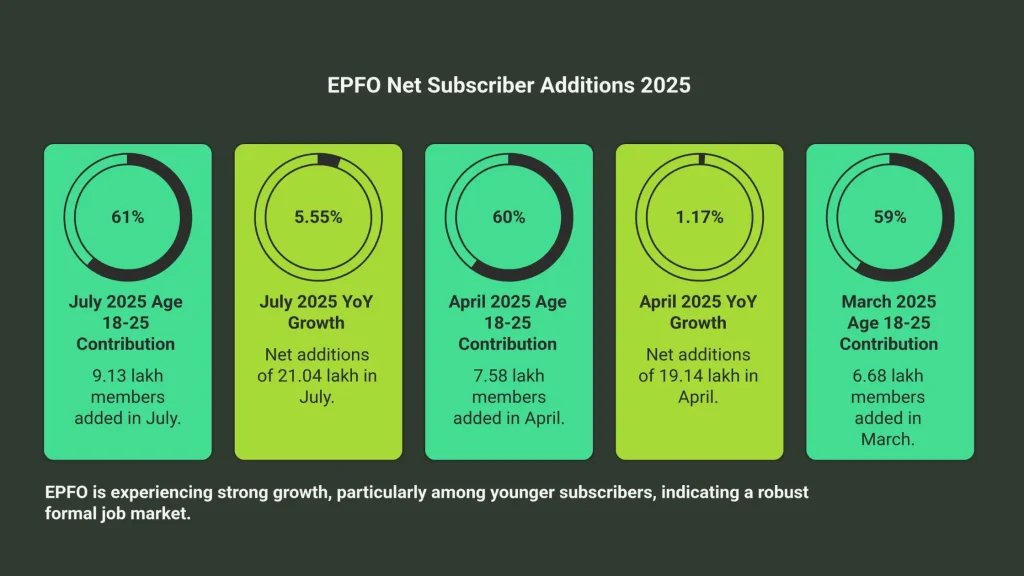
As per EPFO data, over 1.29 crore net subscribers were added to EPFO in 2024-25, with 21.04 lakh net members added in July 2025 alone.
| Month | Net Additions | Age 18-25 Contribution | YoY Growth |
|---|---|---|---|
| July 2025 | 21.04 lakh | 9.13 lakh (61%) | 5.55% |
| April 2025 | 19.14 lakh | 7.58 lakh (60%) | 1.17% |
| March 2025 | 16.26 lakh | 6.68 lakh (59%) | Baseline |
The consistent addition of 19-21 lakh formal jobs monthly means organizations need systems that can screen, schedule, and assess candidates at unprecedented scale.
Youth Entering the Workforce State of Recruitment Automation Q4 2025: Market Trends, Technology Insights & The Future of Hiring
Youth dominate formal employment additions, with 60%+ of new EPFO members in the 18-25 age group. This creates hiring at scale that manual processes simply cannot handle.
Part 2: AI’s Role in India’s Job Future
The NITI Aayog Roadmap: Job Creation Through AI
India’s government and think tanks recognize AI as both a challenge and opportunity. NITI Aayog released the “Roadmap for Job Creation in the AI Economy,” highlighting that India’s tech services sector can create up to 4 million new jobs over the next five years while simultaneously facing displacement of routine roles.
4 million new jobs possible by 2030 2 million
jobs at risk due to displacement
800,000 to 850,000
current AI talent demand
1,250,000
projected AI talent demand by 2026
The National AI Talent Mission
The challenge is clear: India’s AI talent demand is growing at 25% CAGR while existing talent supply grows at only 15% CAGR. This skills gap cannot be addressed through traditional hiring methods.
Organizations need recruitment systems that can identify emerging talent, assess non-traditional qualifications, and rapidly scale hiring for new AI-first roles that didn’t exist two years ago.
Beyond Displacement: The Jobs Multiplier
The key insight: technology disrupts jobs, but it also creates them. Organizations prepared to hire faster will capture disproportionate share of new opportunities.
Part 3: India’s AI Governance Framework—Regulating Recruitment
MeitY’s AI Governance Guidelines: The Regulatory Reality
These guidelines directly impact recruitment automation. Organizations must understand the regulatory landscape:
Seven Core Principles (Sutras):
Human-Centric Development
AI systems in recruitment must prioritize human welfare and put people at the center of design decisions.
Do No Harm
AI recruitment systems must be evaluated for potential harms before deployment, particularly discrimination and bias.
Responsible Innovation
Organizations must balance rapid innovation with responsibility and accountability.
Inclusivity
AI systems cannot perpetuate or amplify existing inequalities in hiring.
Transparency
Organizations must clearly communicate when AI is involved in recruitment decisions.
Accountability
Organizations must establish clear accountability mechanisms and lines of responsibility for AI decisions.
Sustainability
AI systems in recruitment must support long-term, sustainable workforce development.
Sectoral Regulatory Approach
For recruitment specifically, this means:
Ministry of Labour & Employment will oversee labor-related AI regulations
Reserve Bank of India will regulate AI in financial services recruitment
Sectoral regulators will establish domain-specific requirements
MeitY operates as nodal ministry for overall AI governance coordination
What Compliance Requires
Organizations deploying recruitment automation must implement:
–Bias Testing and Auditing
Regular evaluation of AI systems to ensure they don’t discriminate based on caste, gender, religion, or other protected characteristics.
– Transparency and Documentation
Clear records of how AI systems make recruitment decisions, with ability to explain specific candidate rejections.
– Human Oversight Mechanisms
Candidate appeal processes ensuring no one is rejected solely on algorithmic judgment without human review available.
– Risk Assessment and Mitigation
Documented evaluation of potential harms from AI recruitment systems before deployment.
– Grievance Redressal
Clear processes for candidates to report concerns about AI-based screening decisions.
Part 4: Global Job Market Transformation
The World Economic Forum Perspective
| Job Category | 2025-2030 Impact | Key Driver |
|---|---|---|
| Healthcare & Education | Highest growth | Demographic shifts, aging populations |
| AI & Specialist Technology | Rapid growth | AI adoption and advancement |
| Green Energy & Sustainability | Rapid growth | Environmental transition |
| Administrative & Routine Roles | Decline | Automation and AI |
| Graphic Design & Creative Support | Declining | Generative AI capability |
The Skills Gap Crisis
Here’s the critical challenge: 63% of employers cite skills gap as the main barrier to business transformation, with 59 of every 100 workers needing reskilling by 2030.
This means:
120 million workers at medium-term risk of redundancy globally
59% of global workforce requires reskilling or upskilling by 2030
Recruitment automation becomes not just efficiency tool, but survival requirement
Emerging Roles, Emerging Skills
Organizations cannot hire for these new roles through traditional resume screening. Emerging positions include:
- AI Ethics Specialists
- Machine Learning Engineers
- Data Scientists
- AI Trainers and Prompt Engineers
- Digital-First Customer Experience Managers
- Sustainability Specialists
- Cybersecurity Professionals
These roles require fundamentally different recruitment approaches. Candidates won’t have “AI Ethics Specialist” on their resume five years ago because the role didn’t exist.
Recruitment automation enables organizations to identify talent with transferable skills, even when those skills weren’t labeled exactly as needed.
Part 5: The ILO Perspective on AI and Work
International Labour Organization Assessment
24% of global workforce: some AI automation exposure
16.3% of global workforce: medium automation risk
7.5% of global workforce: high-skill automation exposure
The ILO’s Recommendations for India
For recruitment specifically, the ILO recommends:
- Inclusive AI Recruitment Policies:- Ensure automation doesn’t perpetuate existing discrimination in hiring.
- Transparent Hiring Processes:- Clear communication about AI involvement in recruitment decisions.
- Support for Displaced Workers:- Systems to help workers transition between roles as technology changes job requirements.
- Regional Cooperation:- Alignment across borders on AI recruitment standards and practices.
Part 6: Why Recruitment Automation is Imperative Now
The Convergence of Forces
Three factors align to make recruitment automation imperative in Q4 2025:
Force #1: Scale
India is adding 19-21 lakh formal jobs monthly. Manual recruitment cannot scale to handle this volume while maintaining quality.
Force #2: Speed
Global talent expectations have shifted. Candidates expect responses to applications within hours, not days. Organizations that cannot meet this expectation lose candidates to faster competitors.
Force #3: Regulation
MeitY’s AI Governance Guidelines establish compliance requirements that organizations must implement regardless. Compliance-ready automation is better than post-deployment scrambling.
The Competitive Reality
Organizations implementing recruitment automation today gain advantages:
- Speed advantage: Hire in 10-14 days vs. 4-6 weeks
- Quality advantage: AI screening reduces error rates
- Cost advantage: Automation reduces per-hire cost by 20-40%
- Compliance advantage: Built-in governance meets regulatory requirements
- Candidate experience advantage: Responsive automation signals professional, respectful hiring process
Organizations waiting will face:
– Talent flowing to faster competitors
-Compliance challenges (regulations already in place)
-Higher recruitment costs (playing catch-up with multiple implementations)
-Quality challenges (hiring from smaller, weaker candidate pool)
Part 7: Critical Implementation Factors
1. Align with Government Standards
Any recruitment automation implementation should align with MeitY’s India AI Governance Guidelines by building in:
- Bias testing and auditing protocols
- Transparency and documentation systems
- Human oversight mechanisms
- Clear candidate appeal processes
2. Address Skills Gap
Organizations need teams with expertise in:
- AI system configuration and optimization
- Bias evaluation and mitigation
- Regulatory compliance
- Candidate experience design
If internal expertise is unavailable, partner with vendors who have demonstrated this capability.
3. Design for Inclusivity
Recruitment automation must actively work to reduce bias, not perpetuate it. Systems should:
- Test for discrimination across protected characteristics
- Identify and flag potential biases
- Support diverse candidate sourcing
- Enable skills-based, not credentials-based, evaluation
4. Prioritize Candidate Experience
Automation should improve, not degrade, candidate experience:
- Immediate responses to applications
- Clear communication about hiring status
- Transparent explanation of automated decisions
- Accessible appeal mechanisms
5. Plan for Evolution
Regulatory requirements and technology capabilities will evolve. Implement systems that can:
- Accommodate changing compliance requirements
- Integrate new AI capabilities as they mature
- Scale as hiring volume increases
- Adapt to new job roles and skill requirements
Frequently Asked Questions: Q4 2025 Recruitment Automation
Q: Are recruitment automation systems legal in India?
A: Yes. MeitY’s India AI Governance Guidelines explicitly support AI adoption while requiring compliance with principles of transparency, accountability, and non-discrimination. Organizations must implement governance mechanisms, but the technology itself is legally supported.
Q: What specific compliance is required?
A: Organizations deploying recruitment AI must conduct bias testing, maintain transparent documentation of decisions, provide human review pathways, and establish grievance mechanisms. These are currently voluntary best practices, but are likely to become regulatory requirements by 2026.
Q: Will AI replace human recruiters?
A: No. AI handles repetitive, high-volume tasks (screening, scheduling, initial assessment). Human recruiters focus on relationship-building, final hiring decisions, and candidate experience—work that requires human judgment.
Q: How accurate is recruitment AI?
A: WEF research shows that well-designed AI systems match or exceed human performance on structured evaluation tasks, particularly for identifying candidates with relevant skills, regardless of credential background.
Q: What about candidates from non-traditional backgrounds?
A: Properly configured recruitment AI actually improves hiring for non-traditional candidates. Rather than filtering for degrees and job titles, AI can evaluate demonstrated skills, projects, and capabilities—exactly what non-traditional candidates bring.
Q: What’s the ROI timeline?
A: Organizations typically see time-to-hire reductions within 30-60 days. Cost-per-hire reduction becomes apparent within 90 days. Quality-of-hire and retention benefits take 6-12 months to fully manifest.
Conclusion: The Strategic Imperative
Recruitment automation in Q4 2025 isn’t optional.
India’s government has explicitly endorsed AI adoption through MeitY’s Governance Guidelines.
Global trends show 170 million new jobs created by 2030, with AI as primary driver.
India’s formal employment is adding 19-21 lakh jobs monthly, creating unprecedented hiring scale.
The question isn’t whether to automate recruitment. The question is how quickly your organization can do it.
For Indian Organizations: The Particular Urgency
Organizations that build recruitment automation capability now will:
- Capture disproportionate share of emerging talent
- Move faster than competitors
- Meet regulatory requirements from day one
- Provide superior candidate experience
- Build sustainable hiring infrastructure for scaled growth
The infrastructure for AI-powered recruitment exists. The regulatory framework is clear. The business case is proven.
The only remaining question: when will your organization move forward?
About Bot Shreyasi
Bot Shreyasi powers recruitment automation through conversational AI and intelligent candidate screening.
We help organizations:
- Compress hiring timelines (4-6 weeks to 10-14 days)
- Improve candidate experience (24/7 availability, immediate responses)
- Scale hiring capacity (manage 10x candidate volume with same team)
- Build diverse, inclusive teams (skills-based evaluation reduces bias)
Whether you’re expanding hiring to meet India’s growing talent demands, struggling with recruitment scale, or looking to improve candidate experience, we can help you transform your recruitment process with conversational AI designed for India’s unique hiring landscape.
Ready to explore how recruitment automation can accelerate your hiring and meet regulatory requirements?
Let’s talk about your specific challenges and how we can help your organization move faster, smarter, and with full compliance.
Source References
All data in this report comes from official and credible sources:
