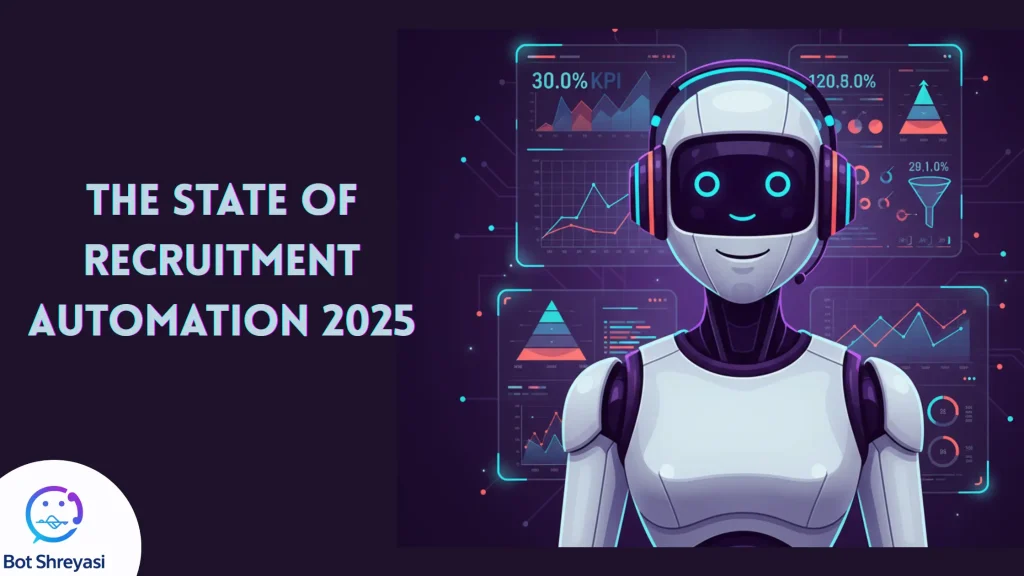
Executive Summary: The Tipping Point for AI-Powered Recruitment Recruitment automation has crossed from innovation to imperative. According to the World Economic Forum’s Future of Jobs Report 2025, 170 million new jobs will be created by 2030 due to technological advancement, with AI and generative technologies driving significant transformation across recruitment and hiring. This isn’t a future scenario. It’s happening right now. 170 million new jobs created by 2030 92 million jobs displaced by technological change The recruitment landscape in Q4 2025 stands at an inflection point. What began as a competitive advantage has become table stakes. Organizations that haven’t implemented AI-powered recruitment are already falling behind in a talent-first economy where speed, precision, and candidate experience determine hiring success. This report examines what’s actually happening in recruitment automation right now: Part 1: India’s Employment Growth—The Foundation for Automation Record Job Creation: The Opportunity India is experiencing unprecedented employment growth that creates urgent pressure for automation. According to the Ministry of Labour & Employment, employment in India rose to 64.33 crore in 2023-24 from 47.5 crore in 2017-18—a net addition of 16.83 crore jobs over six years. 64.33 crore total employed population (2023-24) 16.83 crore net jobs added in 6 years This explosive growth creates a critical challenge: traditional manual recruitment processes cannot scale to meet the hiring demands of a rapidly expanding economy. Formal Employment: The Acceleration The shift toward formal employment is accelerating, creating additional pressure for structured, automated hiring processes. As per EPFO data, over 1.29 crore net subscribers were added to EPFO in 2024-25, with 21.04 lakh net members added in July 2025 alone. Month Net Additions Age 18-25 Contribution YoY Growth July 2025 21.04 lakh 9.13 lakh (61%) 5.55% April 2025 19.14 lakh 7.58 lakh (60%) 1.17% March 2025 16.26 lakh 6.68 lakh (59%) Baseline The consistent addition of 19-21 lakh formal jobs monthly means organizations need systems that can screen, schedule, and assess candidates at unprecedented scale. Youth Entering the Workforce State of Recruitment Automation Q4 2025: Market Trends, Technology Insights & The Future of Hiring Youth dominate formal employment additions, with 60%+ of new EPFO members in the 18-25 age group. This creates hiring at scale that manual processes simply cannot handle. Part 2: AI’s Role in India’s Job Future The NITI Aayog Roadmap: Job Creation Through AI India’s government and think tanks recognize AI as both a challenge and opportunity. NITI Aayog released the “Roadmap for Job Creation in the AI Economy,” highlighting that India’s tech services sector can create up to 4 million new jobs over the next five years while simultaneously facing displacement of routine roles. 4 million new jobs possible by 2030 2 million jobs at risk due to displacement 800,000 to 850,000 current AI talent demand 1,250,000 projected AI talent demand by 2026 The National AI Talent Mission NITI Aayog proposes a National AI Talent Mission to position India as a global AI talent hub, emphasizing the need for reskilling existing workers and developing new AI-first roles like Ethical AI Specialists, AI Trainers, and Sentiment Analysts. The challenge is clear: India’s AI talent demand is growing at 25% CAGR while existing talent supply grows at only 15% CAGR. This skills gap cannot be addressed through traditional hiring methods. Organizations need recruitment systems that can identify emerging talent, assess non-traditional qualifications, and rapidly scale hiring for new AI-first roles that didn’t exist two years ago. Beyond Displacement: The Jobs Multiplier According to ILO projections, while nearly one in four workers worldwide is employed in occupations with some exposure to AI-driven automation, the same technological shift creates demand for specialist roles in AI, data science, and ethical AI—roles that didn’t exist five years ago. The key insight: technology disrupts jobs, but it also creates them. Organizations prepared to hire faster will capture disproportionate share of new opportunities. Part 3: India’s AI Governance Framework—Regulating Recruitment MeitY’s AI Governance Guidelines: The Regulatory Reality In November 2025, the Ministry of Electronics & Information Technology (MeitY) released comprehensive India AI Governance Guidelines, establishing a principles-based framework for safe, trusted AI adoption. These guidelines directly impact recruitment automation. Organizations must understand the regulatory landscape: Seven Core Principles (Sutras): Human-Centric DevelopmentAI systems in recruitment must prioritize human welfare and put people at the center of design decisions. Do No HarmAI recruitment systems must be evaluated for potential harms before deployment, particularly discrimination and bias. Responsible InnovationOrganizations must balance rapid innovation with responsibility and accountability. InclusivityAI systems cannot perpetuate or amplify existing inequalities in hiring. TransparencyOrganizations must clearly communicate when AI is involved in recruitment decisions. AccountabilityOrganizations must establish clear accountability mechanisms and lines of responsibility for AI decisions. SustainabilityAI systems in recruitment must support long-term, sustainable workforce development. Sectoral Regulatory Approach The Guidelines establish that India will adopt a sectoral regulatory approach, with relevant ministries and sectoral regulators formulating AI rules specific to their sectors, rather than a single umbrella law. For recruitment specifically, this means: Ministry of Labour & Employment will oversee labor-related AI regulations Reserve Bank of India will regulate AI in financial services recruitment Sectoral regulators will establish domain-specific requirements MeitY operates as nodal ministry for overall AI governance coordination What Compliance Requires Organizations deploying recruitment automation must implement: –Bias Testing and AuditingRegular evaluation of AI systems to ensure they don’t discriminate based on caste, gender, religion, or other protected characteristics. – Transparency and DocumentationClear records of how AI systems make recruitment decisions, with ability to explain specific candidate rejections. – Human Oversight MechanismsCandidate appeal processes ensuring no one is rejected solely on algorithmic judgment without human review available. – Risk Assessment and MitigationDocumented evaluation of potential harms from AI recruitment systems before deployment. – Grievance RedressalClear processes for candidates to report concerns about AI-based screening decisions. Part 4: Global Job Market Transformation The World Economic Forum Perspective The World Economic Forum’s Future of Jobs Report 2025 reveals that by 2030, 170 million new roles will be created and 92 million displaced, resulting in a net increase of 78 million jobs. Job Category 2025-2030 Impact Key Driver Healthcare & Education Highest growth Demographic shifts,
45 Days to 18: Recruitment Automation Tactics to Slash Hiring Time
Recruitment is no longer just about filling positions, it’s about finding the right talent quickly without compromising quality. In today’s competitive job market, time is of the essence. Lengthy hiring processes can cost organizations top candidates, revenue, and operational efficiency. But what if you could reduce recruitment time by more than half from 45 days to just while still attracting high-quality talent? This blog dives deep into actionable recruitment automation strategies that top companies use to accelerate hiring cycles, optimize workflow, and deliver outstanding results. Why Speed Matters in Recruitment Research from the Society for Human Resource Management (SHRM), 2023 shows that the average time-to-fill a job opening is 42 days, and longer hiring times increase the risk of losing candidates to faster-moving competitors. An extended recruitment process not only frustrates candidates but also raises costs from lost productivity to additional agency fees. Speedy recruitment enhances employer branding and candidate experience, critical drivers for talent attraction. Key Barriers to Faster Hiring Before diving into solutions, it’s essential to understand common bottlenecks in recruitment processes: Recruitment Automation Tactics to Slash Hiring Time 1. Implement Automatic Resume Screening with Smart Filters Rather than manually sifting through hundreds of resumes, automate initial screening using clearly defined job criteria. Automation tools can quickly eliminate unqualified applicants based on skills, experience, and keywords, freeing recruiters to focus on high-potential candidates. Research by Deloitte (2023) shows that companies using automated resume screening cut review time by 60%. 2. Use Scheduling Tools to Streamline Interviews Automated scheduling platforms help align calendars instantly, reducing delays commonly caused by email back-and-forth. Integration with video conferencing further expedites the process, enabling virtual interviews with fewer logistical hurdles, as reported by Forbes (2024). 3. Standardize the Hiring Workflow Establish clear, competency-based evaluation criteria and use collaborative software that tracks candidate progress in real-time. This approach removes ambiguity, enabling quicker consensus among hiring managers and HR teams. Case studies from companies like Google emphasize structured workflows as key to reducing cycle time. 4. Enhance Candidate Communication Prompt, transparent communication is vital. Automate status updates and feedback delivery to candidates to maintain engagement. According to Talent Board’s Candidate Experience Research Report (2025), timely updates increase candidate acceptance rates by over 15%. Case Study: Cutting Hiring Time from 45 Days to 18 A leading tech firm implemented end-to-end recruitment automation across resume screening, interview scheduling, and candidate communication. Result: recruitment cycle time reduced by 60%, while acceptance rates rose by 20%. They reported: Best Practices to Ensure Quality Isn’t Sacrificed Fast hiring doesn’t mean rushed hiring. Ensure your automation: Conclusion: Transform Recruitment with Automation By strategically adopting recruitment automation methods, organizations can achieve significant reductions in hiring time without compromising talent quality. Companies must view speed as a competitive advantage vital for both candidate experience and business growth. Call to Action Ready to see how faster hiring is possible for your organization? Book a personalized demo with us today and experience firsthand how our recruitment automation solutions can cut your hiring time from 45 days to just 18 — without compromising on candidate quality. Schedule Your Demo Now and take the first step toward transforming your recruitment
RPO vs Traditional Recruitment: Why Old-School Staffing is Dying
India’s talent landscape is now driven by real business problems, not old-school hiring rituals. If you’re a business owner, founder, or HR leader, the gap between recruitment process outsourcing India (RPO) and traditional recruitment agencies India is no longer theoretical—it’s visible in the day-to-day struggle to find and keep good people. The Talent Shortage: What Keeps Employers Up at Night In 2025, over 80% of Indian employers say it’s tough to hire the right talent—the highest level among major economies (TeamLease, All Things Talent). Despite millions of graduates joining the workforce each year, less than half of new STEM grads are “job ready.” The skills shortage isn’t limited to IT: fields like GenAI, cloud, and cybersecurity roles are seeing huge demand with few applicants who actually fit the requirements. These challenges don’t just create headaches; they slow down business expansion, increase wage pressures, and lead to high attrition rates—especially in the tech sector, where 33% of new hires leave within a year. The Problem With Old-School Agencies Traditional recruitment agencies in India often work the same way they did a decade ago: post jobs, sift through CVs, and hope for the best. But today, businesses are facing new challenges: The result? Many smaller agencies are struggling—and even closing—because outdated methods can’t keep pace with today’s market needs (TeamLease). AI Recruitment India: How Modern Employers Win Modern businesses are shifting to RPO and AI recruitment India solutions for solid reasons. 96% of Indian professionals already use AI work tools, and major Indian firms like Infosys, TCS, and Wipro use AI to automate screening and halve their hiring time (All Things Talent). Benefits include: The end result: Over 60% of Indian tech firms now use or are exploring RPO providers. These agencies bring in better technology, analytics, and support for employer branding—all the things that help businesses build the workforce they need for growth (Taggd). Real Impact: Cost, Speed, and Quality Let’s compare the numbers: Feature RPO in India Traditional Agencies Average time-to-hire 15–30 days 45–60+ days Cost per hire 30–50% lower than agencies 20–35% of annual salary Quality of hire 20–25% higher (NASSCOM, LinkedIn) Variable and harder to measure Tech use AI, analytics, and automation Manual, limited tech Employer brand support Yes (ongoing) Often minimal Sources: TeamLease, All Things Talent, Taggd. These differences matter: Companies using RPO now report a 3:1 to 5:1 ROI in their first year due to faster hiring, lower costs, and improved retention. The Indian RPO market is expected to reach $420 million by 2027, growing at a CAGR of 15.5% (IMARC, Ken Research), while tech, BFSI, and healthcare are among the fastest-growing sectors for outsourced hiring. User Experience: Good Candidate Engagement is the New Priority Behind all the data, recruitment is still a human story. In India, employee engagement crashed to 19% in 2025—the steepest drop worldwide (TeamLease). A poor hiring process can weaken employer brands and push candidates to look elsewhere. RPO providers now prioritize candidate communication, interview feedback, and onboarding, improving the overall experience and helping retain new starters. What Real Companies Do Differently Top Indian companies working with RPO services focus not just on speed and cost, but also on employer brand, candidate experience, and long-term workforce partnerships. They use data analytics to track hiring outcomes and satisfaction, leading to: In IT Recruitment India, RPO Models Set the Pace The IT sector is a prime example of successful RPO use. Over half of Indian tech job openings now come from Global Capability Centres (GCCs), and the market is set to keep growing by 15-20% annually. (All Things Talent) Modern tech hiring needs: RPO providers are built for this, offering tailored tech hiring solutions and scalable processes that old agencies can’t match. Looking Ahead: Future-Proofing Recruitment By 2031, India’s RPO market could reach USD 18.6 billion, with businesses seeking even more integrated, tech-driven recruitment solutions (Mobility Foresights, IMARC).As remote work expands and new skills become essential, RPO is evolving from just cost-saving to delivering better experiences, diversity hiring, and branding for businesses of all sizes. Useful Links for Deeper Insights Key Takeaway:Acting now is about more than buzzwords. If your business is still spending big and waiting long with traditional recruitment agencies India,.consider how RPO and AI recruitment solutions like Bot Shreyasi offer a new benchmark for hiring: efficient, affordable, and designed to attract the kind of talent that actually drives growth.Your job market will never stand still. With RPO, you don’t have to stand still either. Sources and References:
Recruitment Automation Tools Driving Real ROI in 2025
Hiring teams everywhere are drowning in applications. You’ve probably felt it too—sorting through hundreds of resumes, scheduling interviews that fall through, chasing candidates who ghost, all while your hiring managers keep asking, “When can we fill this role?” The good news? Recruitment automation isn’t just hype anymore. Companies using these tools are cutting time-to-hire in half, saving tens of thousands in agency fees, and actually improving who they hire. But not all automation tools work the same way, and the ROI they deliver varies wildly depending on what you need. This guide breaks down ten recruitment automation platforms that are making real differences for hiring teams in 2025. We’ll look at what makes each one different, share actual results from companies using them, and help you figure out which might work for your situation. Why Automation Matters Now More Than Ever Think about what your recruiters do all day. How much time goes into answering the same candidate questions? Coordinating calendar availability for interviews? Manually screening applications to find the few qualified people buried in the pile? Research shows that 67% of hiring leaders say the biggest advantage of AI in recruitment is simply saving time. And we’re not talking about shaving off a few minutes here and there. Companies report their recruiters save an average of 4.5 hours every single week on repetitive tasks alone. The financial impact adds up fast. When organizations implement AI-powered recruitment tools, they typically see around 30% reduction in cost-per-hire. For a mid-sized company making 100 hires annually, that translates to saving over $140,000 per year. What Makes These Ten Tools Different We evaluated these platforms based on what actually matters: real customer results, unique capabilities that solve specific problems, and verified ROI metrics from independent sources—not just vendor marketing claims. 1. Paradox (Olivia): The Conversational AI That Never Sleeps What it does differently: Paradox built Olivia, an AI assistant who handles candidate conversations 24/7 through text messaging. Unlike basic chatbots that just answer FAQs, Olivia actively moves hiring forward—screening candidates, scheduling interviews, and coordinating onboarding, all through natural conversation. Real results from actual customers: Madison Reed, a retail beauty company, saw their time from application to interview drop by 4 days on average after implementing Olivia. That’s not a small improvement when you’re competing for talent in retail. Checkers & Rally’s saved 35,000 hours annually with automated interview scheduling, achieved 97% application completion rates, and cut 6 days off their time-to-hire. They now have over 90% franchise adoption across their system. One healthcare organization reported that Olivia automated 90% of initial recruiter-candidate interactions, allowing their team to handle 2-3 times the number of open positions they could manage before. Best for: High-volume hiring situations where speed matters—retail, hospitality, healthcare, logistics. Why the ROI works: When you’re hiring hundreds or thousands of people, even small time savings per candidate multiply into massive productivity gains. Sources: Paradox case studies, customer testimonials 2. HireVue: Video Interviewing with Serious Scale What it does differently: HireVue specializes in video-based assessment and interviewing. Their Virtual Job Tryout® gives candidates realistic job previews while helping hiring teams identify who’ll actually succeed in the role. Real results from actual customers: Walmart used HireVue’s Virtual Job Tryout to hire 400,000 new retail associates in just 4.5 months. With a 95% completion rate and millions in measured ROI, they’ve made it their standard assessment tool. Emirates Airlines reduced their hiring cycle from 60 days to 7 days—that’s cutting hiring time by nearly 90%. Holcim reported an 89% increase in hiring speed after implementation. Independent research shows that companies using AI-powered video interviewing see up to 30% reduction in recruitment costs per hire, with 86% of recruiters reporting significantly faster processes. Best for: Enterprise organizations hiring at scale, especially for roles where demonstrating job fit is crucial. Why the ROI works: Video assessments eliminate multiple rounds of phone screens and in-person interviews, dramatically compressing timelines while improving prediction of job performance. Sources: HireVue case studies, customer reports, industry research 3. Zoho Recruit: The All-in-One Budget Champion What it does differently: Zoho Recruit combines applicant tracking with AI-powered automation at a price point small businesses can actually afford. Their Zia AI assistant (built on Zoho’s own language model) generates assessments, optimizes job descriptions, and screens candidates automatically. Real results from actual customers: Full Stack Talent reported their process from profiling to shortlisting candidates went “from days to hours” after implementing Zoho Recruit. Ah Cacao streamlined and automated their entire recruitment process, saving significant time and becoming more responsive to candidates. Multiple customers report productivity improvements from handling 25 tasks per day to 40 tasks per day—a 60% increase. Best for: Small to mid-sized businesses that need comprehensive recruitment automation without enterprise pricing. Why the ROI works: You get end-to-end automation—sourcing, screening, assessment generation, interview coordination—for a fraction of what you’d pay for separate point solutions. Sources: Zoho Recruit customer testimonials, case studies 4. Fetcher: Proactive Sourcing on Autopilot What it does differently: While most tools wait for candidates to apply, Fetcher actively hunts for qualified people who haven’t even started looking yet. Their AI searches across 45+ platforms, identifies relevant candidates, and automatically reaches out with personalized messages. Real results: Fetcher users report building qualified pipelines of passive candidates, significantly reducing dependence on expensive job boards and agency recruiters. The platform combines AI-powered search with human review to ensure diversity and quality. Best for: Companies hiring for specialized roles or trying to build diverse talent pipelines proactively rather than reactively. Why the ROI works: You’re accessing candidates unavailable through traditional channels and building relationships before you urgently need to fill a role, dramatically shortening time-to-hire when positions open. Sources: Fetcher platform capabilities, customer reports 5. Bot Shreyasi:the all-in-one Virtual AI Recruiter What it does differently: Bot Shreyasi uses voice-based conversational AI to conduct actual interviews, not just collect information. It evaluates candidates using structured frameworks including CBTE (Competency-Based Technical Evaluation), CEFR (language proficiency), and CTR (cognitive and behavioral traits). Positioning context:Bot Shreyasi is an
5 Major Benefits of Voice AI in Recruitment: The 2026 Hiring Guide
If you’re in recruitment, you already know how hard it is to keep up with high candidate volumes. In fact, understanding the benefits of voice AI in recruitment is essential, as the adoption of automated voice interviewing is redefining the way recruiters hire talent in 2026. Because HR teams face increasing pressure to act fast, remain fair, and still find top-quality candidates, using voice AI for recruitment is no longer a futuristic tool. Instead, it serves as today’s essential competitive edge for modern talent acquisition. In this guide, we explore how voice-based technology is changing the game. Furthermore, we examine why modern HR leaders are switching from conventional methods to autonomous Voice AI Recruiters to scale their operations and maximize their output. What is a Voice AI Recruiter? A voice AI recruiter is a conversational AI tool that conducts automated voice interviews. Instead of relying on humans to manually screen each applicant, these tools speak to candidates, ask screening questions, and evaluate their responses using natural language processing (NLP) and machine learning models. Beyond just recording answers, the 2026 generation of voice AI actively analyzes: Consequently, this creates a structured candidate report for the recruiter, without requiring any human to make a single manual screening call. Key Benefits of Voice AI in Recruitment for High-Volume Challenges 1. How to Screen 1000s of Candidates in One Day Imagine being able to interview 500 people in one evening. That is the power of recruitment automation. Specifically, candidates receive a voice call and answer predefined questions while the AI evaluates their performance simultaneously. This level of scale remains impossible for traditional human-led screening. 2. Reducing Hiring Bias with Standardized Interviews Bias can sneak into even the most well-meaning hiring processes. However, one of the greatest benefits of voice AI in recruitment is that it provides a bias-free environment because: 3. Making Data-Backed Decisions Faster Voice AI platforms generate structured data, including scores on communication, behavioral traits, and domain knowledge. As a result, this allows HR teams to: 4. Maximizing Recruitment ROI and Saving Resources Recruiters often spend 30–45 minutes per screening call. If you multiply that by 100 applicants, your team spends 75+ hours on just initial conversations. By using an AI voice agent for recruitment, you cut this time down to minutes. Therefore, your team can focus on high-level strategy and final-stage engagement, which is one of the financial benefits of voice AI in recruitment. 5. Enhancing Candidate Experience with 24/7 Flexibility Today’s job seekers value speed and convenience. For this reason, voice AI offers several advantages: Real-Life Examples: Witnessing the Benefits of Voice AI in Recruitment Staffing agencies using voice AI have already seen a 2x improvement in outreach response rates. Furthermore, companies using Bot Shreyasi, our specialized voice AI for recruitment, report: “I was skeptical at first, but Bot Shreyasi helped me screen 200 candidates while I slept,” says one of our clients from a mid-sized tech company. This demonstrates the real-world impact of recruitment automation. Seamless Integration into Your 2026 HR Ecosystem Modern voice AI tools integrate effortlessly with your existing stack. For example: Consequently, this ensures your entire recruitment workflow remains automated, from the initial application to the final shortlist. Future Outlook: The Synergy of Human & AI Voice AI does not replace recruiters; rather, it supports better human judgment. Final interviews, culture fit, and team alignment still require empathy and strategic thinking. However, for the first round of screening, AI handles the heavy lifting to ensure consistency, speed, and scale. Final Thoughts: Don’t Just Hire Fast, Hire Smart Voice AI serves as the backbone of a modern recruitment strategy. By focusing on the benefits of voice AI for recruitment, your team can save time, reduce bias, and make confident hiring decisions faster than ever before. Ready to scale your hiring? Book a Free Demo of Bot Shreyasi and see how our Voice AI Recruiter can transform your hiring ROI in 2026.
Talent Acquisition Automation: How to Reduce Hiring Time by 50%
Talent acquisition and Hiring top talent quickly is one of the biggest challenges HR teams face today. The longer a position remains unfilled, the more it impacts productivity, team morale, and company growth. However, with AI-powered recruitment software and automated hiring solutions, businesses can significantly reduce hiring time while improving the quality of hires. Traditional hiring processes are time-consuming, involving tasks like screening resumes, scheduling interviews, and following up with candidates. On average, it takes 36 days to fill a position, according to SHRM. However, companies leveraging recruitment automation software reduce this time by up to 50%—meaning positions are filled in 18 days or less. This is where AI recruitment tools like Bot Shreyasi can be transformative. By automating repetitive tasks and enhancing decision-making, these tools allow HR teams to focus on strategic hiring decisions rather than administrative bottlenecks. Here’s how automated recruiting solutions streamline hiring: 1. Automated Resume Screening One of the major bottlenecks in hiring is the manual screening of resumes. AI-powered recruitment process automation tools scan thousands of resumes in seconds, filtering the most relevant candidates based on skills, experience, and job fit. This alone can save up to 23 hours per job opening. 2. AI-Powered Candidate Matching Advanced recruitment AI solutions use machine learning to match candidates with job descriptions more accurately than manual screening. These systems analyze past hiring data to predict which candidates are most likely to succeed, reducing the risk of bad hires. 3. Instant Candidate Engagement Delays in communication are a major reason hiring processes drag on. Automated hiring solutions like Bot Shreyasi can engage with candidates 24/7 through AI-driven chatbots and voice assistants. This ensures that candidates receive immediate responses to queries and progress updates, keeping them engaged and reducing dropout rates. 4. Efficient Interview Scheduling Coordinating interviews between hiring managers and candidates can be a logistical nightmare. HR automation software integrates with calendar tools to schedule interviews instantly, eliminating back-and-forth emails. Some companies report reducing scheduling time by up to 80% using automation. 5. Faster Background Checks AI-powered talent acquisition automation tools integrate with background check providers to verify candidate details in real-time. This accelerates the verification process, ensuring faster onboarding. By implementing the best recruitment automation platforms, companies experience: Organizations looking for AI-powered recruitment software need a solution that seamlessly integrates with their existing HR processes. Bot Shreyasi helps companies automate hiring while maintaining a human touch. Leveraging conversational AI ensures HR teams spend more time building relationships and making data-driven hiring decisions. In today’s competitive job market, recruitment process automation tools are no longer optional—they’re essential. By automating tasks like resume screening, interview scheduling, and candidate engagement, businesses can reduce hiring time by 50% or more, securing top talent before competitors do. If you’re ready to revolutionize your hiring process, explore how Bot Shreyasi can help streamline recruitment for your business. Faster, smarter, and more efficient hiring starts today!
Are AI Chatbots Still Effective in Recruitment Automation?
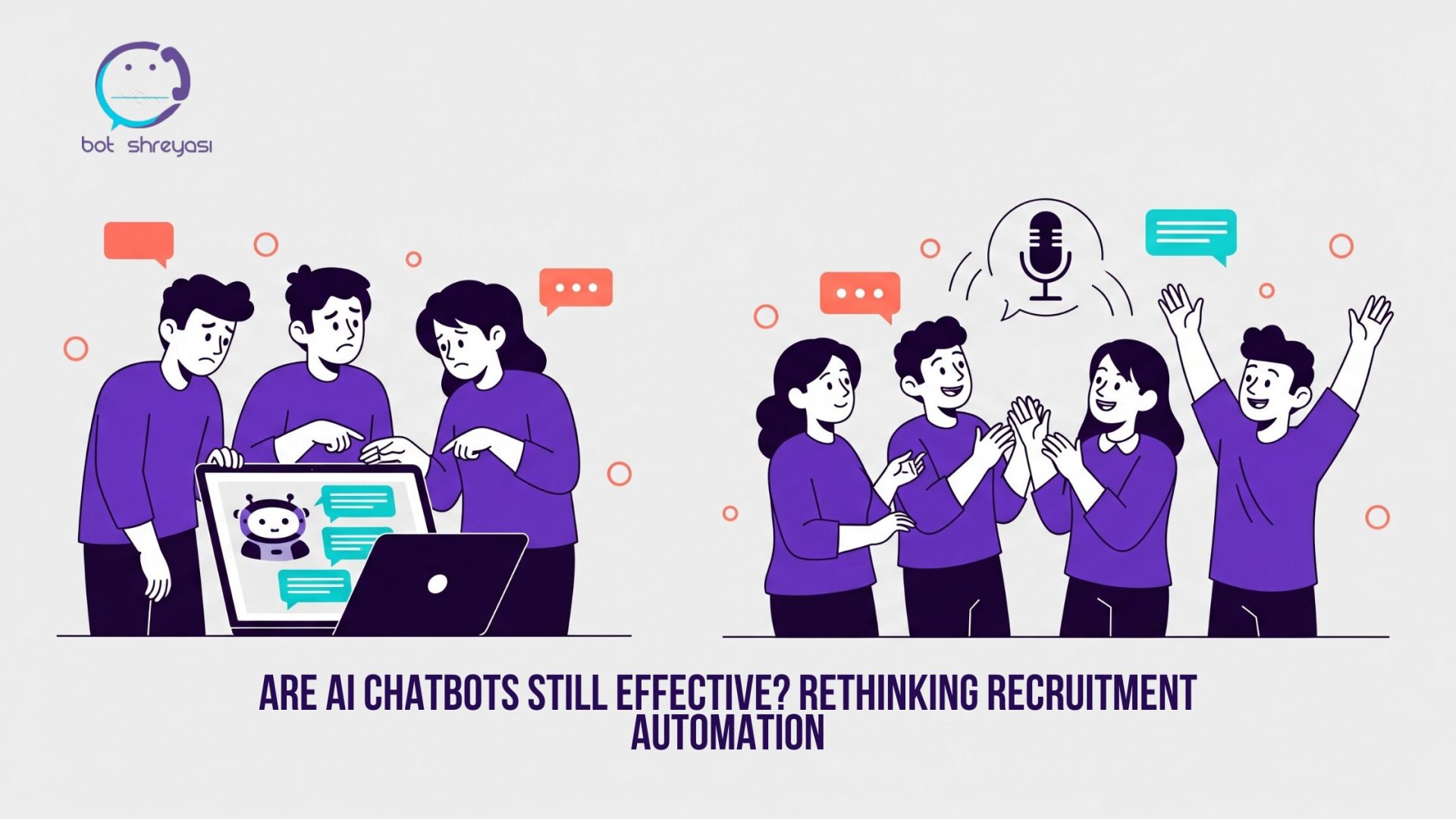
Recruitment automation is evolving quickly. While AI chatbots were once considered cutting-edge, they’re now being overshadowed by voicebots that deliver faster, smarter, and more human-like hiring experiences. Companies using only chatbots for recruitment automation may be missing out on critical opportunities to connect with modern candidates. A decade ago, recruitment chatbots helped automate repetitive tasks—like screening resumes or answering FAQs—freeing up time for HR teams. But today’s job seekers expect more. They want instant, engaging, and personalized interactions. Traditional chatbots can come across as stiff, unhelpful, and overly scripted, which leaves candidates feeling disconnected. This is exactly where voicebots change the game offering a more natural, responsive, and engaging way to interact during the hiring process. AI chatbots operate using written text and fixed conversation flows, which limits their ability to adapt or respond meaningfully beyond what they’re programmed to say. This makes their conversations rigid and often unhelpful for anything beyond simple queries. For example, when a candidate asks about growth opportunities, a chatbot usually offers a canned response. Voicebots, powered by advanced NLP, can engage in dynamic dialogue and respond contextually—just like a human recruiter. Typing answers to scripted chatbot questions can feel cold and transactional. Modern candidates want quick and real-time feedback, but chatbots often fall short. This leads to frustration and application drop-offs. In contrast, voicebots allow candidates to speak naturally and receive instant, personalized responses, keeping them engaged and reducing abandonment rates. Chatbots do well with simple tasks like answering common questions or conducting basic screenings, but they fall short when it comes to managing more complex stages of the hiring process. They can’t conduct meaningful interviews or assess soft skills, intent, or tone. Voicebots, however, can manage high-volume recruitment by conducting automated interviews, analyzing voice responses, and identifying qualified candidates at scale. Voice-based AI recruitment tools are transforming how companies hire. Unlike text-based AI chatbots, voicebots create a more conversational and interactive experience. Here’s how voicebots are leading the future: Bot Shreyasi is a leading voicebot designed to streamline hiring through real-time voice conversations. It automates interviews, evaluates responses, schedules follow-ups, and works seamlessly with existing recruitment software. Bot Shreyasi represents the next leap in recruitment automation—beyond AI chatbots. Feature AI Chatbots Voice-Based AI (Voicebots) Interaction Mode Text-only Voice + Text Personalization Limited Highly tailored Task Complexity Basic queries Screening + Initial Interviews Scalability Struggles with high volume Scales efficiently Candidate Experience Impersonal Engaging & human-like Data Insights Basic keyword matching NLP-driven tone & intent analysis As recruitment automation evolves, AI chatbots are no longer enough. Their text-based, scripted limitations prevent them from delivering the personalized, real-time interactions today’s candidates expect. Voicebots, on the other hand, provide a smarter and more engaging experience. By adopting voice-based AI like Bot Shreyasi, companies can automate recruitment tasks, improve candidate engagement, and scale hiring operations, all while offering a human-like interaction that chatbots simply can’t match. Voicebots aren’t a distant innovation, they’re already reshaping how recruitment automation works today.
ATS vs HRMS: Key Differences & Why You Need Both
We are in the year 2025, and AI has become an essential ingredient without which no recipe tastes quite right, whether it’s the automobile industry, smartphone industry, or recruitment, for that matter. AI plays an important role in making it efficient, productive, and simpler. Most recruitment agencies nowadays are still using ATS software (Applicant Tracking Systems) and HRMS solutions (Human Resource Management Systems) to streamline their hiring processes. These systems assist recruiters with organizing job listings, filtering applications, arranging interviews, and streamlining overall hiring operations. But here’s the challenge many agencies now face: ATS and HRMS systems alone are no longer enough. As job seekers demand more and hiring gets increasingly competitive, agencies relying only on these systems are likely missing out on opportunities to stand out and perform better. Together, they build a reliable base for recruitment automation. But they don’t cover everything, especially when it comes to creating a great candidate experience, offering real personalisation, or making smarter, faster hiring decisions. Agencies using ATS or HRMS software usually enjoy: These benefits are valuable. But they also show just how much more is possible when newer technologies are added to the mix. Feature ATS (Applicant Tracking System) HRMS (Human Resource Mgmt System) Primary Goal Hire the right people (External focus) Manage employees (Internal focus) User Recruiters & Candidates HR Admins & Employees Key Stage Sourcing to Offer Letter Onboarding to Retirement Data Resumes, Interview scores Payroll, Attendance, Performance Example Tool Greenhouse, Lever BambooHR, Workday The Gap: Why ATS + HRMS Still Isn’t Enough Even though ATS and HRMS platforms are helpful, they can also cause gaps in your recruitment strategy. Many systems use fixed filters that screen out candidates who don’t fit traditional criteria: Industry reports suggest that a significant portion of qualified applicants may be unintentionally filtered out by overly rigid automated screening systems. Automated emails and form-based applications lack the warmth and human touch candidates want today: Whereas a more human-like and real conversation can be more engaging for the candidates as compared to a robotic and dull conversation. Agencies collect a lot of data, but it often stays unused: Blind trust in automation has its downsides: Recruiters still need to apply judgement to make sure good talent isn’t being lost. Modern applicants want: Most ATS and HRMS tools aren’t built for that level of interaction. This is where next-gen tools like Bot Shreyasi come in. Here things get interesting, a Voice AI recruiter brings a new layer of smart, conversational automation that works alongside your existing ATS or HRMS. These tools: They don’t replace your platforms, they elevate them. Feature Traditional ATS / HRMS With Voice AI Recruiter Resume Parsing Yes Yes Job Posting Yes Yes Communication Mostly Text-Based Real-Time Voice + Text Screening Rule-Based Filtering Intelligent Conversations Personalization Low High Talent Rediscovery Rare AI-Powered Search Candidate Experience Basic Forms Natural, Engaging Dialogues Language Support Limited Multilingual If your agency wants to stay ahead of the curve, consider: 1. Pairing Your ATS/HRMS with Voice AI Don’t replace your current system. Add tools that enhance it with better engagement and communication. 2. Blending Automation with Human Interaction Use automation to handle the first steps. Let your recruiters take over where human judgement matters most. 3. Making Use of Your Candidate Database Revisit past applicants using smart search and rediscovery tools to save time and cost. 4. Reviewing Your Filters Keep algorithms fair and inclusive. Check them often to avoid missing out on great talent. 5. Focusing on the Candidate Experience The better your hiring journey feels, the more likely top talent will complete it. Make the process responsive, mobile-friendly, and human. Final Thoughts This doesn’t mean at all that ATS and HRMS are completely obsolete and you should ditch your ATS or HRMS right away. But if that’s all that you are using, you are missing an important piece of the puzzle. Using them alone could mean you’re losing out on talent, speed, and insight. Adding voice-based AI tools like Bot Shreyasi helps you combine the structure of traditional systems with the conversational, smart experience candidates expect today. So here’s the real question: Are you just tracking applicants, or are you truly connecting with them?
AI Recruitment Tools Are Transforming Hiring in India- Bot Shreyasi
In today’s fast-moving business world, speed and efficiency in hiring can give companies a big advantage. AI-powered recruitment tools like Bot Shreyasi are transforming how companies hire. By bringing AI into the recruitment process, companies using Bot Shreyasi are now able to hire faster and smarter. In many cases, recruitment speed has doubled. So what’s working so well, and how can you bring similar results to your own hiring? Let’s start with the basics. Traditional hiring takes time. Reading resumes, setting up interviews, and evaluating candidates can stretch over weeks or months. It also eats up a lot of team energy. AI tools, like the ones offered by Bot Shreyasi, help simplify this process by taking over repetitive tasks and improving decision-making through structured data. Bot Shreyasi is a great example of how voice-based AI recruitment tools are changing the game. Using powerful algorithms, our system filters through large volumes of candidate data to highlight the most relevant matches. This means your HR team spends less time on manual screening and more time talking to the right people. It also helps improve hiring quality by minimising personal bias in the early stages. If you’re thinking about using AI in your recruitment process, start by getting clear on what you need. What skills or qualities matter most for your roles? Once that’s defined, tools like Bot Shreyasi can be trained to screen and prioritise candidates based on those exact needs. Another key thing to remember is that AI doesn’t replace your recruiters. It works alongside them. Think of it as a co-pilot that takes care of the initial screening, so your team can focus on interviews, engagement, and final decisions. Of course, data privacy is critical. Any AI hiring tool you use must follow data protection rules and handle candidate information with care. Bot Shreyasi is built with security in mind, so your data stays protected. Lastly, be ready to refine the process. AI tools perform best when they learn over time. Track your results, look at what’s working, and make adjustments. That’s how you get the most value out of the system. In short, Bot Shreyasi shows that with the right recruitment tools and a thoughtful approach, AI can speed up your hiring, cut down on effort, and help you build stronger teams.
Voice AI Recruiters & Bias-Free Hiring: Hype or Game-Changer?
Voice AI Recruiters and Unconscious Bias: Can Technology Make Hiring Fairer? Hiring the right talent has always been challenging, but what if you are hunting for the right talent, but your decision-making is clouded by your own biases, without you even noticing? . Despite the best intentions, human decisions are often influenced by factors such as names, voices, accents, gender, and even cultural cues. This is known as unconscious bias. The rise of Voice AI Recruiters and broader AI in HR presents a fresh opportunity to make hiring more consistent, inclusive, and data-driven. But can this technology truly eliminate bias, or are we simply shifting it into a digital format? What Is a Voice AI Recruiter? A Voice AI Recruiter is an intelligent hiring assistant that conducts automated voice-based conversations with job candidates. It takes care of the early interview stages like pre-screening and screening of candidates with human-like, unbiased voice interactions, no favoritism, no fatigue, and no assumptions. Understanding Types of Unconscious Bias To understand the value of AI in reducing hiring bias, it’s important to recognize the common types of unconscious bias that affect human decision-making: These biases are often unintentional but deeply embedded, which makes them hard to overcome without structured intervention. How AI in HR Is Transforming Recruitment AI in HR goes beyond automation; it’s about smarter, faster, and more equitable hiring decisions. Here’s how: When combined with a Voice AI Recruiter, this creates a recruitment process that’s both scalable and fair from the first interaction. Recruitment Automation with a Human Mission Recruitment automation doesn’t just cut down on manual work; it helps eliminate unconscious bias by reducing variability in decision-making. Voice-based AI platforms offer: These features are designed to support diversity hiring efforts while improving both speed and accuracy. Addressing Ethical Risks in AI Recruiting AI can be fair, but it depends on the data used to train it. If your past hiring trends favoured a narrow demographic, there’s a risk your AI may mirror those patterns. That’s why ethical implementation matters: Recruiters must continuously monitor AI tools to identify any unintended biases and ensure algorithms adapt to evolving fairness standards. Best Practices for Using Voice AI Recruiters For companies looking to integrate Voice AI Recruiters effectively, they can consider the following practices: These steps ensure the technology empowers fair decision-making while maintaining a human-centered approach. Hypothetical Use Case: A More Inclusive Hiring Experience Imagine a company seeking to hire for a customer support role. Traditionally, because of unconscious bias, candidates with local accents and English fluency were favored more. But by switching to a Voice AI Recruiter, all candidates will have to answer predefined, structured, and job-relevant questions only. Hence, over time, the company sees a measurable increase in hires from underrepresented regions. Managers report higher satisfaction with new hires, who were selected purely based on their responses and talent, not their tone or background. Practical Example: Bot Shreyasi in Action Bot Shreyasi demonstrates how a thoughtfully designed Voice AI Recruiter can enhance the hiring process. It combines structured voice interviews with automation to help organisations screen candidates fairly and at scale. Common Concerns About Voice AI in Hiring Conclusion: Technology Alone Isn’t Enough AI in HR and Voice AI Recruiters offer incredible potential to transform how we hire. But the key to removing unconscious bias lies in how we use this technology, not just that we use it. It requires: When paired with ethical practices and continuous improvement, AI recruiting can move us closer to the inclusive workforce we envision.